
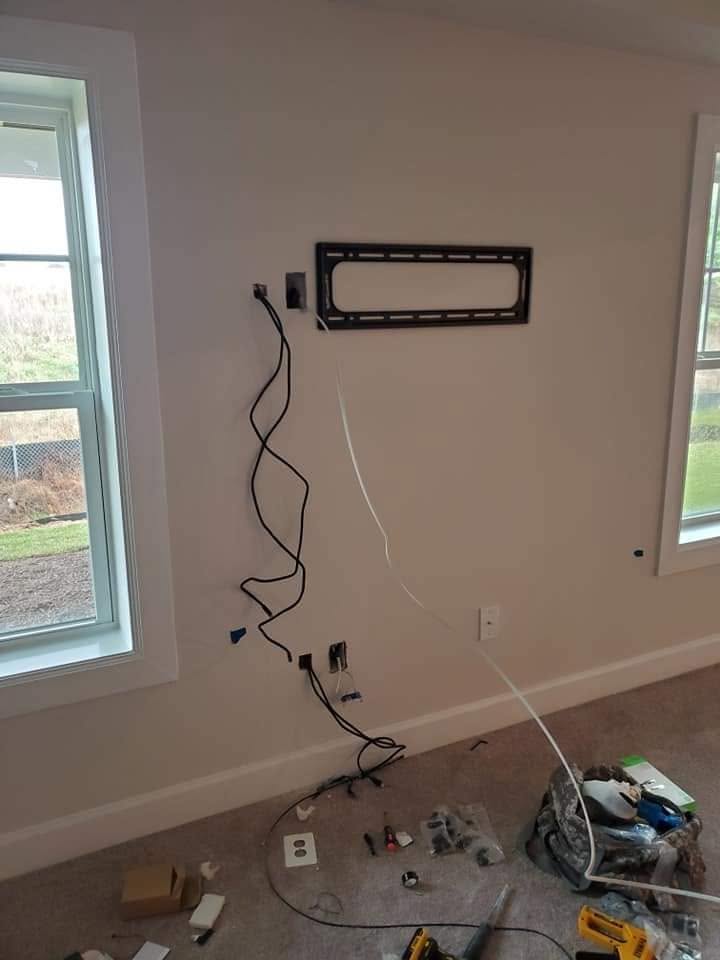
Why the outlet position matters
A wall-mounted TV looks finished when nothing hangs below it, and a cord running down to a low outlet spoils that. Pushing a standard power cord inside the wall to hide it isn't safe either, because household cords aren't made to sit inside walls. The tidy answer is to bring power to where the TV is.
Where the outlet should go
Behind the TV, roughly in the middle of the screen area, so the screen hides the plug and the cord stays short. A recessed outlet sits back into the wall, so even a slim TV mounted close to the wall clears it. If a soundbar, streaming box or Frame One Connect box needs power too, plan for those at the same time.
Three ways to get power there
- A new recessed outlet behind the TV gives the cleanest finish. It's electrical work, so a qualified person should do it.
- An in-wall rated power kit carries power from an existing outlet lower on the wall up to the TV through in-wall rated cable.
- On brick, stone or concrete, where the wall can't be opened, the cord runs up in a slim paintable channel.
Plan the outlet around the mount
Decide where the bracket goes first, then place the outlet. The bracket shouldn't cover the outlet, and the outlet has to land inside the area the screen will hide. If you might move to a bigger TV later, keep the outlet near the middle so a larger screen still covers it.
Above a fireplace
The fireplace wall rarely has an outlet in the right place. If it's framed with drywall, the cables can usually run inside, with a recessed outlet or an in-wall rated kit behind the TV. If the chimney is brick or stone all the way up, the cord runs in a slim paintable channel instead. See above-fireplace TV mounting for the height and heat checks that go with it.
Outdoor and patio TVs
Outside, the outlet has to be outdoor-rated and ground-fault (GFCI) protected, and close enough that the TV's cord reaches it without crossing a walkway. Our outdoor TV planning guide also covers cover, sun and surfaces.
The HDMI and other cables
HDMI, network and speaker cables can run inside drywall to a wall plate near your cable box or console, so nothing shows below the screen. See TV cable concealment for the options.
Can you use an extension cord behind the TV?
Not as a permanent fix. Extension cords and power strips aren't meant to run inside a wall, and a cord hanging down to a low outlet is the look you were trying to avoid. A recessed outlet or an in-wall rated kit does the job safely.
Things to check before you decide
- What the wall is made of. Drywall can usually be opened; masonry usually can't.
- Where the nearest outlet is, and what else runs on that circuit.
- What else will plug in behind the TV.
- Whether you rent. Landlords and condo associations may have rules about electrical changes.
How we handle it
We fit TV outlets for homes and businesses in Baltimore and across Maryland. We look at the wall, the circuit and your equipment, recommend the option that suits, and do the electrical work in the same visit as the mount. We're fully licensed and insured. Ask about TV power or see Electrical Services.